The Spirit of Revolution by Drucilla Cornell & Stephen D. Seely
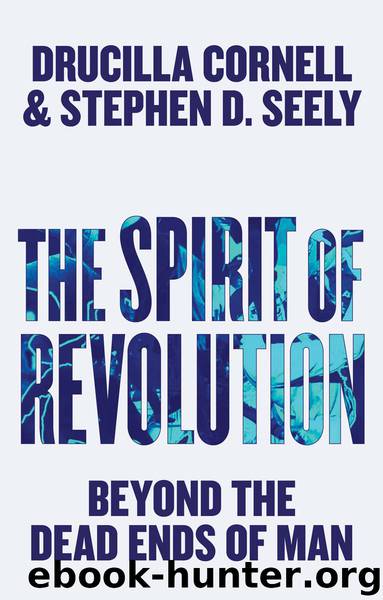
Author:Drucilla Cornell & Stephen D. Seely
Language: eng
Format: epub
ISBN: 9780745690780
Publisher: Wiley
Published: 2015-12-25T00:00:00+00:00
The subject’s relation to das Ding is so determinative of the psychic organization because, again due to the pleasure principle, the psychic system seeks to stabilize itself around the initial conditions of loss in the primary narcissistic trauma—the subject’s “castration,” or the loss of the primary (m)Other. Because this loss is the first shock to the subject’s psychic apparatus, it is preserved in the unconscious which stabilizes around it, driving the subject’s desire but always within the domain of the pleasure principle. (This is, of course, why for Lacan and Edelman jouissance is considered to be “beyond” the pleasure principle—the return to the limitless jouissance of the (m)Other, or the discovery of the Thing, would utterly overwhelm the subject.) Yet, given that this primary Other, the first object of loss—the Thing—is unconscious, we must represent it metaphorically or metonymically. Lacan’s reading of the Thing thus adds a psychoanalytic insight to Kant’s transcendental analysis of the conditions of possibility of experience: there is a certain hallucinatory element as a condition of representation that fills in what is always absent (1992: 52–3).
This brings us to the relationship between the Real and the Thing for Lacan. The Real is not equivalent to the Thing. Rather, the Thing is “that which in the Real suffers from the signifier,” that is, the trauma mandated by the fact that no representations can be “faithful” to “it” (Lacan 1992: 125). The failure to adequately grasp the Thing brings us to the barrier of the Real—the limits of our Symbolic and Imaginary representations—which forces us back to the traumatic Thing in an endless search that Freud called the “compulsion to repeat” (see 1990). The Thing is what results from the cut of the Phallic signifier, which is what rips us from the jouissance of the primary (m)Other and delivers us over to the Symbolic order, while the Real is what remains beyond the scar left by this cut. We know that the Thing is missing in our Symbolic representations, which forever drives our search for knowledge of it (and is why we have a drive to acquire knowledge at all, given that the pleasure principle would seem to prohibit this), but this Thing is forever beyond our knowledge. The Real is thus, for Lacan, the hole in the Symbolic order left by the primary cut, which carved out the Thing. And yet, in Lacan’s work, this hole will always be reduced to Woman. And why is this the case? This reduction is ultimately an effect of the logic of castration that grounds the entire Lacanian system. As we discussed above, through the acceptance of the paternal Law we “accept” castration, which allows us to fend off our capture by the jouissance of the (m)Other and take up a position as a speaking subject in the Symbolic order. Each person thus begins the process of becoming a subject in a pre-Oedipal, Imaginary state of fusion with the primary (m)Other who serves as the specular image of the ego. It
Download
This site does not store any files on its server. We only index and link to content provided by other sites. Please contact the content providers to delete copyright contents if any and email us, we'll remove relevant links or contents immediately.
| Anthropology | Archaeology |
| Philosophy | Politics & Government |
| Social Sciences | Sociology |
| Women's Studies |
The remains of the day by Kazuo Ishiguro(9085)
Tools of Titans by Timothy Ferriss(8492)
Giovanni's Room by James Baldwin(7436)
The Black Swan by Nassim Nicholas Taleb(7195)
Inner Engineering: A Yogi's Guide to Joy by Sadhguru(6835)
The Way of Zen by Alan W. Watts(6671)
The Power of Now: A Guide to Spiritual Enlightenment by Eckhart Tolle(5854)
Asking the Right Questions: A Guide to Critical Thinking by M. Neil Browne & Stuart M. Keeley(5831)
The Six Wives Of Henry VIII (WOMEN IN HISTORY) by Fraser Antonia(5558)
Astrophysics for People in a Hurry by Neil DeGrasse Tyson(5224)
Housekeeping by Marilynne Robinson(4504)
Double Down (Diary of a Wimpy Kid Book 11) by Jeff Kinney(4333)
12 Rules for Life by Jordan B. Peterson(4331)
Ikigai by Héctor García & Francesc Miralles(4311)
The Ethical Slut by Janet W. Hardy(4307)
Skin in the Game by Nassim Nicholas Taleb(4306)
The Art of Happiness by The Dalai Lama(4169)
Skin in the Game: Hidden Asymmetries in Daily Life by Nassim Nicholas Taleb(4051)
Walking by Henry David Thoreau(4000)
